Gold just had an ugly week. Look at who kept buying anyway – and you’ll see what the headline missed.
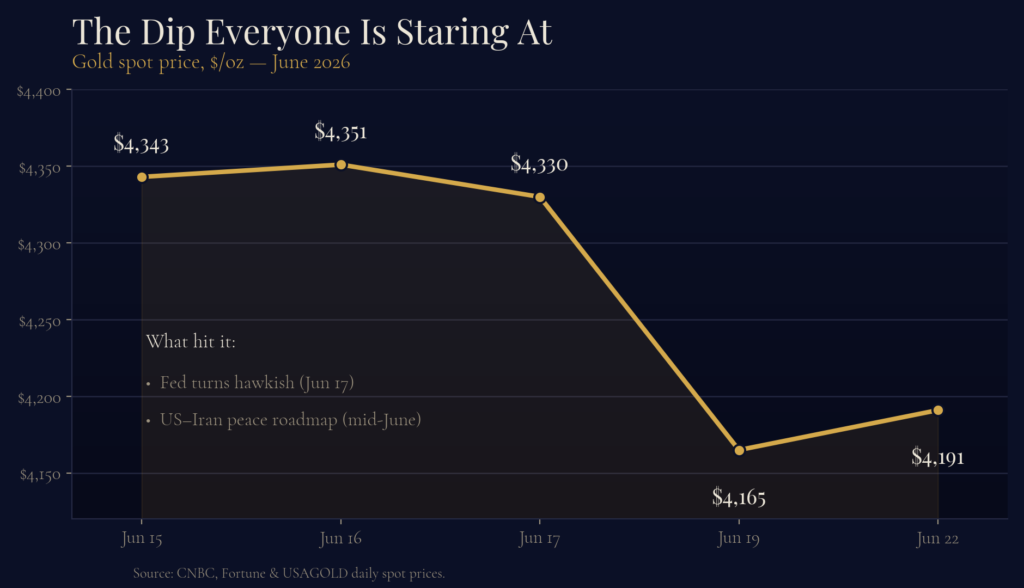
Gold should have been flying. War risk was high. Hormuz was tense. Oil was jumpy. U.S. inflation had hit 4.2% in May. Gasoline was up sharply. This is usually the perfect recipe for gold. And yet gold fell.
From around $4,350 an ounce, it slipped near $4,190. The market had a neat explanation: Washington and Tehran signed a peace roadmap, oil cooled, the dollar strengthened, and the Fed sounded hawkish. Fair enough. Gold pays no interest. So when the dollar rises and interest rates look higher, gold usually sulks in the corner.
But that is the trader’s story. The real story was happening somewhere else. Not on the screen. In the vault.
The buyers who don’t panic
While hedge funds sold gold on the peace headline, China kept buying. The People’s Bank of China bought gold for the nineteenth month in a row, taking its official holdings above 2,300 tonnes. That is not a trade. Nobody buys gold for nineteen straight months because they saw a nice chart pattern. That is policy. And the policy is simple:
Own something nobody can freeze.
A dollar in a foreign account is useful. A U.S. Treasury is liquid. A euro reserve is respectable. But they all have one problem. They live inside someone else’s system. Gold in your own vault does not. That difference used to sound like gold-bug poetry. Then Russia happened.
Russia changed the room
In 2022, the West froze roughly $300 billion of Russia’s central-bank reserves. You may agree with that. You may think Russia deserved it. You may think it was the right move. But every finance ministry in the world learned the same lesson:
Your reserves are only yours until someone bigger decides they are not.
That is the uncomfortable bit. If your money sits in another country’s financial plumbing, it can be blocked. Frozen. Immobilised. Politically switched off. Gold is different. A gold bar does not need SWIFT. It does not need a correspondent bank. It does not need permission. It just sits there, heavy and annoying outside the system.
That is why central banks are buying. Not because they love shiny objects. Because they love optionality.
Even friends are getting nervous
This is not only about China or Russia. Germany still keeps more than 1,200 tonnes of gold in New York. For decades, that was normal. America was the anchor. The vault was safe. Nobody asked too many questions. Now German politicians are asking whether more gold should come home. The Bundesbank says there is no plan. Of course it does.
Central banks do not say, “We are slightly worried about our best friend holding our gold.” They say things like “storage strategy” and “diversification.” But the debate itself matters. When enemies want their gold back, fine. When allies start asking, pay attention.
That is not a price story. That is a trust story.
Gold has quietly become the anti-sanction asset
This is the part the daily market misses. Gold has now overtaken U.S. Treasuries as the world’s second-largest reserve asset, around 27% of global official reserves, versus roughly 22% for Treasuries. That is a big deal hidden inside a boring statistic. For years, Treasuries were the king of reserves. Gold was the old relic in the basement. Now the relic has walked past the king.
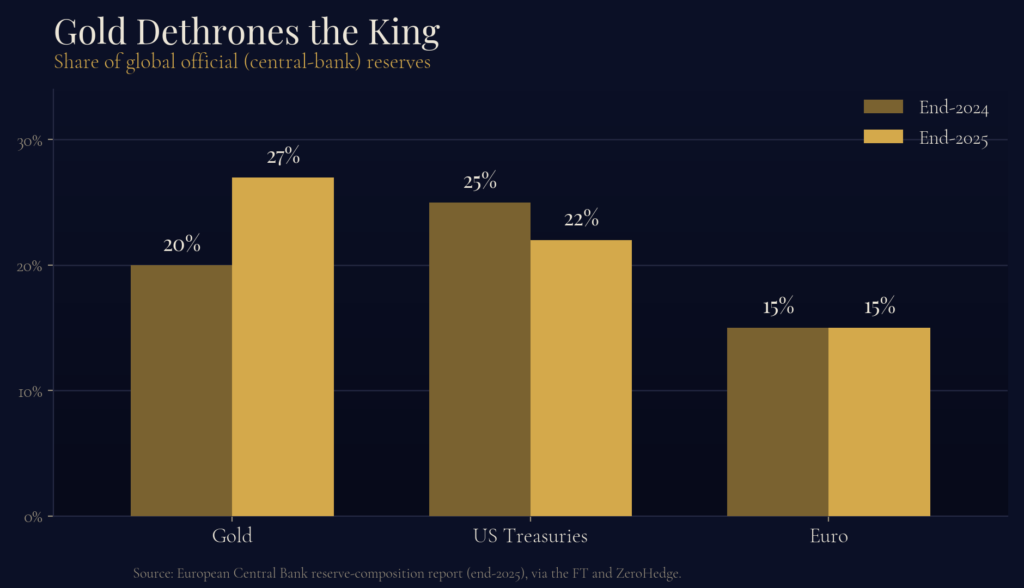
Gold dethrones the king – gold has overtaken Treasuries in global central-bank reserves.
Central-bank gold buying has also changed gear since 2022. Before the Russia freeze, buying was steady. After the freeze, it surged. More than 1,000 tonnes were bought annually in the following years, and even a slower year was still huge by old standards.
The World Gold Council says a record 45% of surveyed central banks plan to buy more gold. That is not Reddit. That is not a doomsday newsletter. That is the official sector quietly saying:
Maybe we want less paper and more metal.
So why did gold fall?
Because two things can be true. Gold can have a bad week. And still be in a long-term bull story. The short-term clock cares about the Fed, the dollar, oil, peace deals and positioning. On that clock, gold had real headwinds. Peace deal? Bad for gold. Stronger dollar? Bad for gold. Hawkish Fed? Bad for gold. So yes, the dip makes sense.
But the long-term clock cares about something bigger: sanctions, frozen reserves, Ukraine, Taiwan, Hormuz, and whether your money is truly yours if it sits abroad. On that clock, gold is not a trade. It is insurance. That is the whole point.
Near term, gold can be capped. Long term, it is still bid. The short clock won the week. The long clock may win the decade.
The market looked at gold and saw a price drop. Central banks looked at gold and saw a lock without a keyhole. That is why this story is bigger than inflation. Bigger than oil. Bigger than one peace deal. Gold is becoming the asset countries buy when they no longer fully trust the system that holds their money.
You can freeze a bank account. You can block a transfer. You can immobilise a bond. You can sanction a country’s reserves. But a gold bar sitting in your own vault? That is harder. Much harder.
And that is why, even in a bad week for gold, the buyers who matter kept buying. Because they are not betting on next week’s chart. They are preparing for the next time money becomes a weapon.
You can sanction a payment. You can sanction a bank.
But you can’t sanction a gold bar.