India became the world’s number one ship-recycling nation. That is a real win. It is also a warning we should read carefully.
Here is a sentence that sounds like a triumph and is, if you tilt your head, a confession.
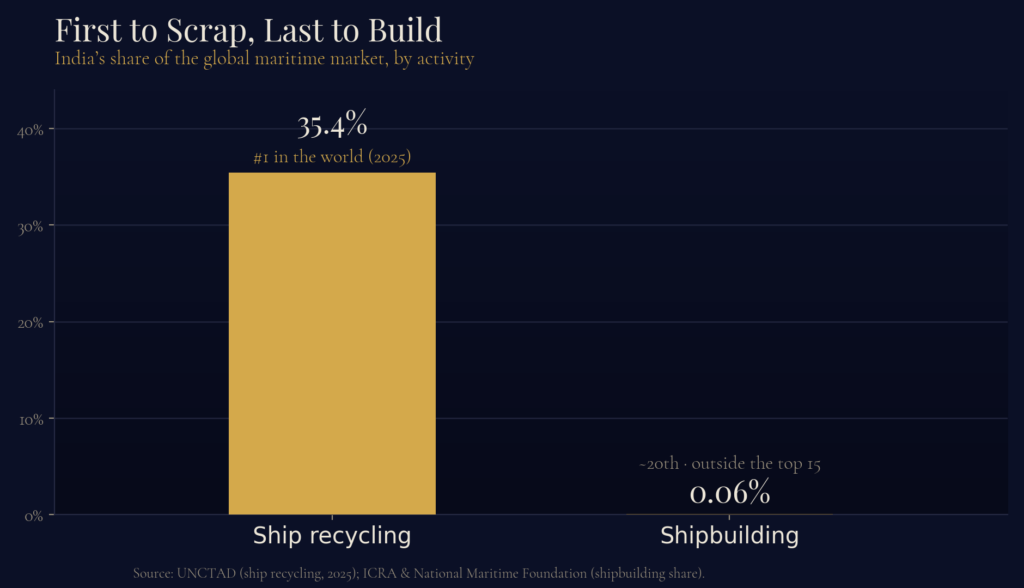
In 2025 India became the world’s largest ship-recycling nation. Its share of the global business jumped to 35.4%, up from 30.1% the year before, and the volume of steel scrapped rose almost 60% in a single year. India hit a target it had set for 2030, five years early.
The minister called it a milestone. It is.
Now read it again, slowly, because there is a second sentence hiding inside the first.
India is number one in the world at taking ships apart. And India is barely anywhere at making them. Its share of global shipbuilding is about 0.06%. Not six percent. Not 0.6. India does not crack the top 15 builders on earth, while China, South Korea and Japan split almost the entire market between them, and China alone now turns out more than half the world’s merchant tonnage.
So put the two facts side by side, because nobody in the celebration wants to. We are first in the world at the end of a ship’s life. We are nearly last at the start of it.
That is the whole problem in one line.
The scrapyard is good. It is also the cheap seat.
Let me be fair to recycling, because the win is genuine and the work has cleaned up. India dragged a notorious industry up to international standard, ratified the Hong Kong Convention, passed the Recycling of Ships Act, and pushed 115 yards into compliance. There is real money and real employment in the 16,000 ships due for the breaker over the next decade. This is not nothing. It is a hard, unglamorous thing done well.
But let us not flatter ourselves about what recycling actually is.
The bottom of the value chain. It is where a ship goes to die and you get paid for the weight. By its nature it is among the dirtiest and most dangerous industrial work there is, tidal flats soaked in oil and heavy metal, men cutting hulls apart by hand. India has made it cleaner and safer, and should be proud of that. But “cleaner, safer scrapyard” is a different ambition from “we build the thing.”
A country that builds ships sells design, engineering, propulsion, and thirty years of service contracts. A country that scraps them sells tonnage. One is a brain business. The other is a muscle business. We just won the muscle business and are calling it a vision.
Cheap labour does not build a ship. An ecosystem does.
This is the Indian reflex we need to break: the belief that if an industry needs a lot of hands, India wins it by default. That works for assembly. It works for services. It does not work here.
A ship is not stitched together like a shirt. It is designed, financed, classed, insured, welded from marine-grade steel, fitted with propulsion and navigation systems, tested, and then supported for three decades. Labour is the easy part. The moat is everything around it: the steel mill, the engine, the electronics, the dry dock, the classification approval, the supplier two streets away who can make the one part you forgot, and a bank willing to fund a build that takes years to deliver.
That is exactly the stack India does not have. Which is why private capital keeps standing at the door without coming in. No serious investor builds critical mass out of patriotism. Capital follows critical mass, it does not create it, and shipbuilding needs the mass to exist before the money will believe in it.
We are brilliant at demand. We keep flinching at depth.
This is bigger than ships, and it is the most Indian thing in the whole story. We are world-class at building markets. We built the payment rails, the delivery apps, the platforms, the demand. And then, in sector after sector, we stop right before the hard part: the materials, the machines, the components, the tooling, the testing, the certification, the systems integration where the real expertise lives.
Without that depth, cheap labour is just a discount. With it, labour becomes leverage. Shipbuilding shows the gap at its most brutal. We have the coastline, 95% of our trade moves by sea, and we own roughly 1,526 ships, about 1.2% of global tonnage. The cargo is ours. The ports are ours. The risk is ours. The vessel, very often, is not.
And so we pay. India hands over something like $75 billion a year in sea freight, much of it to foreign-owned ships. That is roughly the size of the entire defence budget, leaking out quietly every year under a line called “transport services,” while we argue about everything except the boats.
The new weapon is not a missile. It is a route.
Here is where this stops being an economics seminar and becomes a security one.
The old picture of national power was easy to draw: tanks, jets, submarines, missiles. The new one is duller and meaner. A denied insurance line. A sanctioned shipowner. A blocked payment. A port that will not let you dock. A spare part that never ships. A foreign vessel that is mysteriously unavailable the exact week you need it.
Modern wars do not always begin with explosions. Sometimes they begin with paperwork. And if your trade rides on other people’s ships, your trade rides on other people’s politics. That is fine in a calm world. We are not in a calm world, and we have just spent a season watching the Strait of Hormuz behave like a valve someone else controls. Movement is power, and right now we rent ours.